When the Costume Speaks
When the Costume Speaks

Joanna Van Kampen on costume and the strange psychology of becoming someone else.
Jo and I first met at LAMDA in the 1990s. We learnt our craft together, spent countless hours in rehearsal rooms and dressing rooms. Later we shared a home, navigating those uncertain years after drama school, when the safety of that creative cocoon fell abruptly away and the world outside felt suddenly, terrifyingly real.
Our careers eventually took us in different directions. Jo built an extraordinary career across theatre, television, film and radio. I found myself irresistibly drawn towards costume instead. There was an awful lot of time spent loitering with intent around the wardrobe department. While everyone else was watching the drama unfold, I was usually staring at a hemline, wondering why on earth someone had decided a character experiencing a mental breakdown should do so in bias-cut silk.
Still, I’ve often thought we’re both asking versions of the exact same question.
How do we become someone?
Actors know something the rest of us rarely articulate. Clothing doesn’t simply illustrate character. It helps create it.
Jo’s career offers an unusual vantage point on this. She’s played Fallon Rogers in Radio 4’s The Archers for twenty-six years now. She still can’t quite believe it herself. There is no costume on radio. No hair and make-up. No audience watching her walk into a room. Only a voice, floating into kitchens while people chop onions.
Alongside that, decades on stage and screen, where clothing is never simply clothing. It becomes armour. Sometimes leverage.
Same actress. Same relentless instinct for the truth of a moment. The only variable is whether anyone can actually see what she’s wearing on her lower half.
I wanted to know what happens when the clothes disappear.
So let me ask the obvious question first.
Does costume actually do any of the acting for you?
“You definitely do most of the work during rehearsals,” Jo says. “But then something else happens when you find your costume.”
She tells me about Mike Alfreds, who directed her at the RSC in 2004, and who filled the rehearsal room with rails of clothes, trunks of hats, shoes, props. Actors trying things on for hours before anyone had learned a line.
“It was like playing dress-up as a kid.”
Which, when you think about it, is an astonishingly respectable way of describing professional, high-art British theatre. It makes me wonder whether actors are simply the only adults still permitted to admit something the rest of us spend our lives pretending isn’t true: that clothes do in fact change us.
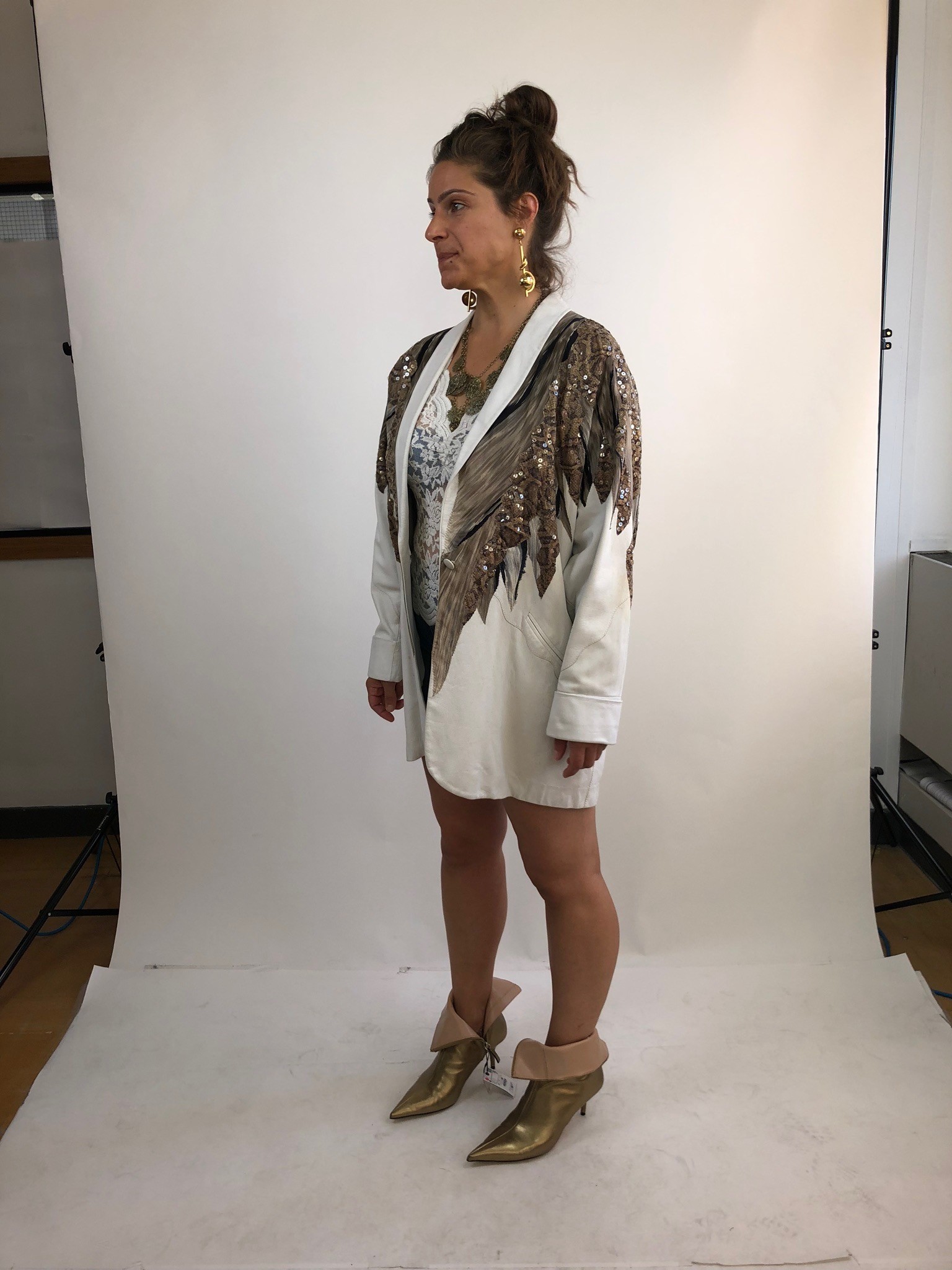
One fitting becomes another. For Brave New World, Jo is a glamorous survivor of a future gone wrong. Loud jewellery, wild hair, and, memorably, gold stilettos she had absolutely no business filming in.
Then, on location, she fell over.
“The director liked the look of the bloody knees, so disinfectant and plasters had to wait. I liked the feel of the pain on my knees with the heavy jangly jewellery and crazy hair. It made me feel suitably unhinged for the scene.”
Only an actor calls a grazed knee useful research.
Of course, costume only does that work when it’s on your side.
Sometimes it isn’t.
Thinking back to our final year at LAMDA, one memory has stayed with me. The production itself slips my mind. What I do remember, with absolute clarity, is what it felt like to be twenty-two, standing on a stage in front of a dark auditorium full of agents and casting directors, knowing that before you’d even opened your mouth, people had already decided what sort of woman you were, and whether the industry had any use for her. It was the first time I understood that a woman’s body enters a room long before her talent does.
You once told me you nearly cried in the costume fitting for that showcase. I’ve realised I’ve never actually asked you why.
“I remember trying not to cry in the costume fitting,” Jo says. “My costume was basically one piece of cheap material with holes cut out for my arms. I was unhappy with my body at that time, but I wanted to feel good onstage. This costume felt like they had given up trying to make me look good and just thought, let’s cover her in a tent. It’s not how I wanted to feel, and it wasn’t my best performance. I don’t remember all that much about it. It certainly wouldn’t have helped the industry professionals place me within the industry, which was the point of those final year performances.”
I ask Jo, were you upset because the costume was ugly, or because it made you feel unseen?
“Ugh, both,” Jo says. “There seemed to be no effort in the design. It wasn’t a garment that was going to highlight anything, elevate anything about me, my body or the character. It seemed to be just covering up. Hiding. Therefore yes, I felt unseen. And then, because the costume was ugly, I felt upset at what I saw in the mirror, not inspired. The material was cheap, not finished properly. I was playing a princess but I felt like crap. It was hard also I guess to be playing a girl and having the body of a woman. It felt easier when I was playing an older woman or a butch lesbian in another final year show. I didn’t have to be a ‘pretty young thing’. A lot of that is a reflection of the industry and what they expect to see.”
I wonder if that was the first time you realised costume isn’t neutral. It’s another voice in the room, telling the audience, and sometimes the actor, who they think you are. Did that experience make you speak up more in fittings, or less?
“I can’t honestly remember if that was the first time I felt that. I suspect it may have been earlier. I played the witch in Hansel and Gretel in primary school and had a crazy bright green curly wig, which I remember feeling mad in, in a helpful way. I think that experience did eventually make me realise that a costume fitting is collaborative and that speaking up is essential. For a long time I just thought that the costume designer knew better and I had to just put on what they presented.”

Costume, it turns out, has firm opinions about your spine as well as your soul
I ask Jo whether clothing changes behaviour, not just appearance, and she doesn’t hesitate.
“A corset is a great example of a costume item that will alter the way you hold yourself. You can’t slouch or relax. It feels like you’re on show. Your breathing apparatus is quite restricted, so the breaths you take become shallower. Everything becomes more heightened, jeopardy more impactful. You can begin to understand why women were fainting in plays where corsets are worn.”
So, Victorian women weren’t being dramatic. They were simply trying to inhale.
She offers a contrast: Teresa, in Alan Ayckbourn’s How the Other Half Loves, a new mother buckling under the weight of a life she can no longer keep up with.
“This dressing gown and nightdress were very key for me in presenting that image of a woman on the verge of breakdown. The consequence of wearing something like that, with no make-up, is you feel a certain amount of vulnerability. Of powerlessness.”

Did dressing that way for the role change how you felt when you took the costume off at the end of the night?
“Yes it did! It stayed with me when we went to the pub afterwards. That feeling of low-key dressing, no make-up. I remember on a day off, we, the cast, went for a walk and pub lunch, and I thought, yay, I can put on make-up and dress up a bit! Like they hadn’t really seen me in my vibrancy yet or something.”
If the dressing gown stripped away her armour, the detective’s wardrobe built it from the outside in.
“When I finally got my costume it just elevated it,” Jo notes, recalling a specific jumper that paid homage to a famous Swedish TV detective. “I felt secure in the knowledge that the audience would get the joke just from my first appearance.”
I ask whether that confidence came from the jumper or from her.
“Generated internally,” she says, “but the costume can build on what confidence you’ve already got.”
So perhaps confidence itself can’t be bought. But something adjacent to it, the shorthand of being instantly understood, sometimes can, and occasionally it comes in the form of a jumper doing an enormous amount of quiet, unpaid work.

Twenty-six years complicates all of this rather beautifully. Nobody has ever once seen what Fallon is wearing, including, arguably, Jo.
“There is a sense of freedom in that,” Jo says, of working purely in voice. “You can use purely your voice to create any character you wish, and there is no limitation other than your vocal ability.”
And what’s left, once the visual disappears entirely?
“My and the audience’s imaginations. Everybody’s image of the character in their head is totally unique to them. That’s rather beautiful. Allowing an audience that freedom to create with you.”
Radio, you’d think, is surely the one place clothing finally becomes irrelevant.
Not quite.
“It’s not something I think about too much when I go in to record,” Jo says of Fallon’s wardrobe, “but in my head she is a dungarees and headscarf kind of gal. She loves vintage furniture, music, and is extremely creative. A singer, a cook. Practical, but fun in her style.”
Then, almost as an aside, the detail that undoes the entire premise of costume disappearing on radio at all.
“I did get given a skirt to wear in studio for Fallon’s wedding day. It wasn’t a big skirt, she wore a shortish sixties vintage dress, not a meringue. I also wore shoes with the right kind of heel.”
None of it visible to a single listener. All of it there so the fabric would move correctly near a microphone, so the sound of Fallon’s wedding day would be true. Costume hasn’t disappeared on radio at all. It’s changed function, from something seen to something heard.

[Photo: Fallon and Harrison (James Cartwright) in The Archers]
Has she used that trick elsewhere?
“I think only on the radio. The sound of jewellery for Fallon sometimes, and we were given heavy coats for when we were recording the flood in Ambridge, I seem to remember… It does happen onstage too, do you remember Richard Morris having to wear squeaky shoes in The Cherry Orchard? His character, Yepikhodov, refers to it!”
Off stage, Jo is considerably more relaxed.
“Gosh, I have no idea,” she says, when I ask whether decades of becoming other people has changed how she dresses herself day to day. “I guess it will have done. It’s probably made me more relaxed, knowing I get to dress up in all kinds of fun things fairly regularly. So I maybe think less about what I wear day to day, and enjoy being comfortable. And conversely, maybe there’s also a willingness to dress dramatically, having worn things onstage that could potentially make you feel quite uneasy.”
That casualness doesn’t extend to a role, though. After a career of corsets and gowns, I ask if there’s anything left in her own wardrobe she wouldn’t put a character in, or whether vanity simply stops applying once she’s playing someone else.
“I would like to think there’s nothing in my wardrobe, or anywhere, that I wouldn’t wear if I truly felt it served the character. It’s funny because there’s definitely stuff still in there that I wouldn’t wear in real life because they’re not flattering or whatever, and that would matter to me. But if I’m dressing as a character I quite relish the challenge of losing vanity. If it serves the story.”
That kind of surrender asks a lot of trust, especially once the curtain’s about to go up and there’s nowhere left to hide. So I ask about the fear itself, whether it’s still there after all these years, that moment before stepping onstage when you feel you could genuinely die. Has it subsided at all, compared to when she started?
“I’ve definitely had major panic. Like the time I was taking part in a drama festival on the Olivier stage at the National Theatre. I was performing a duologue and I had to come on before my partner, to deliver a short soliloquy to the audience. It was coming up to my entrance and they were announcing our names and the scene onstage and I couldn’t remember my first line. My scene partner was waiting in the wings on the opposite side of the stage, so I couldn’t ask him. I remember going to different stage managers saying, ‘have you got a script?’ I was actually freaking out. Then the announcer finished our introduction, the audience clapped and the stage manager looked at me and mouthed, ‘Go.’ So I had to go. I strode out onto the stage, still not knowing my line, got to the front of the stage and opened my mouth, still not knowing my line, and the line came out. And the speech came out. I think that’s what’s known as muscle memory. Your body knows and remembers. I think these days I have learnt to trust that, and have learnt to come back to myself via various techniques. So if I feel that fear rising, I can work with it, talk it down or breathe through it. It’s just a voice, a part of you that is scared. It’s not the whole truth and it doesn’t run you. So, yes, the possibility is always there but it has definitely subsided.”
One role, though, I can’t quite let go of.
I recall when Jo was offered the chance to play Maria Callas, someone she has always admired, and turned it down. She said she felt too young, that she worried she didn’t yet have the emotional weight to carry the role. I’ve thought about that a lot over the years.
I actually think that was a really brave decision. Most actors would have said yes and hoped for the best. You said no. What did you think you hadn’t lived through yet? And looking back, do you think you were right?
“Thank you, I was scared to let everyone down, but I was more scared to go onstage and not be ready. I was asked to understudy Jane Lapotaire, who was playing Maria Callas. It was practically a one-woman show and I felt I needed more support than that. I would have wanted to do a deep dive into her life, spend a couple of months preparing. Maria Callas was an idol for me, so the idea of me doing a half-arsed job, it would have been painful for me and disrespectful to her. I was only twenty-one, just out of drama school, and the play was about Callas at the end of her career, in her fifties. It felt wrong to attempt it at that stage in my life.
“I think, actually, at my young age, I had been through some similar things, weight issues, emotional turbulence, a sense of heartbreak. But what I wouldn’t have had was the gravitas that just comes with age and experience. And performance-wise, probably that stillness that I feel has been developing over the years. So, yes, I do think I was right, looking back. Poor Jane was actually taken ill during the run so I would have had to go on. Maybe it would have been an opportunity, but I don’t think so. I have no regrets.”
Which leaves the question of what she’d bring to Callas now that she couldn’t have brought then.
“Just that sense of things winding down somehow, most of the fireworks and drama having passed. I’m not quite at that stage but I’m closer to it. Although I feel in my own life, at the peri-menopausal stage, that I’m actually coming into empowerment, and this time in life can feel like a huge awakening for women, in this play, Callas is coping with the loss of her singing voice, so she maybe had the feeling that you are past your prime, and your glory days are in the distance. That relationship that you have with younger people, the desire to pass on your wisdom and experience. Your frustration at them.
“So, in the play, Masterclass by Terence McNally, Maria Callas is taking a masterclass with a few young opera singers. I think, as a young actress, that would have been a challenge. To relate to those other characters in that unique way that a mentor does a mentee, to have that status. In my life now, having two adult children, been through divorce, worked on myself, having coached and taught young actors and gained so much more experience on stage and basically been knocked about a bit, I feel I could begin to contemplate it.”
There’s another woman Jo still carries, and this is the one I know something about first-hand.
“I do still carry Ranyevskaya, from The Cherry Orchard,” Jo says. “You were in this production with me, Ayesha, playing Varya, in our final year at LAMDA. I just really felt like I understood her. This is another part I was too young to play at the time. If I was asked now, I would jump at it.”
“Yes, you’d be perfect for her now,” I tell her. I still remember playing Varya alongside her, both of us bound by the heavy, unforgiving tailoring of the period. I remember those corsets too. Not exactly designed with comfort in mind.

[Photo: Ayesha Mirza, Joanna Van Kampen and Richard Armitage in The Cherry Orchard]
That structural imposition isn’t always temporary; sometimes a character leaves a physical scar. Greta Ohlsson, in Murder on the Orient Express, a woman so wrought with tension and fear that Jo tied her own body in knots playing her.
“I’ve never been the same since,” she says. The costumes for that production were handmade to the finest period detail, wigs included. “It felt authentic. It added depth to all our characterisations.”

[Photo: Greta Ohlsson and Princess Dragomiroff (Joanna McCallum), Murder on the Orient Express, Chichester Festival Theatre]

[Photo: costume design sketch of Greta]
If some costumes offer sanctuary, others simply won’t let go. I ask whether she has ever kept a piece of clothing from a role.
“I have. It was a coat I wore to play Rachel Watson in The Girl on the Train. That coat became such a big part of the character. It protected her, hid her, engulfed her. I also kind of needed one for winter, and I quite liked it.”
I ask if she still has it, where it lives these days.
“I actually don’t. I was attached to it for a while and then I thought, do you know what, I don’t want this coat now. It still had a bit of stage blood on it that I couldn’t get out. But more than that I just suddenly went off it. It was so tied up with Rachel, the character who wore it, and her identity. Maybe it held all the character’s trauma and I didn’t want to carry that around anymore. Even she didn’t wear it by the last scene of the play, it was symbolic. She was free, allowing herself to be seen and start again.”

[Photo: The Girl on the Train, Salisbury Theatre]
Looking back, I realise I wasn’t watching the clothes after all.
I was watching what they allowed people to become.
Jo understands that instinctively. Twenty-six years and several hundred costumes in.
Perhaps the rest of us understand it too.
We just happen to call it getting dressed.
When the Costume Speaks
Joanna Van Kampen on costume and the strange psychology of becoming someone else.
Jo and I first met at LAMDA in the 1990s. We learnt our craft together, spent countless hours in rehearsal rooms and dressing rooms. Later we shared a home, navigating those uncertain years after drama school, when the safety of that creative cocoon fell abruptly away and the world outside felt suddenly, terrifyingly real.
Our careers eventually took us in different directions. Jo built an extraordinary career across theatre, television, film and radio. I found myself irresistibly drawn towards costume instead. There was an awful lot of time spent loitering with intent around the wardrobe department. While everyone else was watching the drama unfold, I was usually staring at a hemline, wondering why on earth someone had decided a character experiencing a mental breakdown should do so in bias-cut silk.
Still, I’ve often thought we’re both asking versions of the exact same question.
How do we become someone?
Actors know something the rest of us rarely articulate. Clothing doesn’t simply illustrate character. It helps create it.
Jo’s career offers an unusual vantage point on this. She’s played Fallon Rogers in Radio 4’s The Archers for twenty-six years now. She still can’t quite believe it herself. There is no costume on radio. No hair and make-up. No audience watching her walk into a room. Only a voice, floating into kitchens while people chop onions.
Alongside that, decades on stage and screen, where clothing is never simply clothing. It becomes armour. Sometimes leverage.
Same actress. Same relentless instinct for the truth of a moment. The only variable is whether anyone can actually see what she’s wearing on her lower half.
I wanted to know what happens when the clothes disappear.
So let me ask the obvious question first.
Does costume actually do any of the acting for you?
“You definitely do most of the work during rehearsals,” Jo says. “But then something else happens when you find your costume.”
She tells me about Mike Alfreds, who directed her at the RSC in 2004, and who filled the rehearsal room with rails of clothes, trunks of hats, shoes, props. Actors trying things on for hours before anyone had learned a line.
“It was like playing dress-up as a kid.”
Which, when you think about it, is an astonishingly respectable way of describing professional, high-art British theatre. It makes me wonder whether actors are simply the only adults still permitted to admit something the rest of us spend our lives pretending isn’t true: that clothes do in fact change us.
One fitting becomes another. For Brave New World, Jo is a glamorous survivor of a future gone wrong. Loud jewellery, wild hair, and, memorably, gold stilettos she had absolutely no business filming in.
Then, on location, she fell over.
“The director liked the look of the bloody knees, so disinfectant and plasters had to wait. I liked the feel of the pain on my knees with the heavy jangly jewellery and crazy hair. It made me feel suitably unhinged for the scene.”
Only an actor calls a grazed knee useful research.
Of course, costume only does that work when it’s on your side.
Sometimes it isn’t.
Thinking back to our final year at LAMDA, one memory has stayed with me. The production itself slips my mind. What I do remember, with absolute clarity, is what it felt like to be twenty-two, standing on a stage in front of a dark auditorium full of agents and casting directors, knowing that before you’d even opened your mouth, people had already decided what sort of woman you were, and whether the industry had any use for her. It was the first time I understood that a woman’s body enters a room long before her talent does.
You once told me you nearly cried in the costume fitting for that showcase. I’ve realised I’ve never actually asked you why.
“I remember trying not to cry in the costume fitting,” Jo says. “My costume was basically one piece of cheap material with holes cut out for my arms. I was unhappy with my body at that time, but I wanted to feel good onstage. This costume felt like they had given up trying to make me look good and just thought, let’s cover her in a tent. It’s not how I wanted to feel, and it wasn’t my best performance. I don’t remember all that much about it. It certainly wouldn’t have helped the industry professionals place me within the industry, which was the point of those final year performances.”
I ask Jo, were you upset because the costume was ugly, or because it made you feel unseen?
“Ugh, both,” Jo says. “There seemed to be no effort in the design. It wasn’t a garment that was going to highlight anything, elevate anything about me, my body or the character. It seemed to be just covering up. Hiding. Therefore yes, I felt unseen. And then, because the costume was ugly, I felt upset at what I saw in the mirror, not inspired. The material was cheap, not finished properly. I was playing a princess but I felt like crap. It was hard also I guess to be playing a girl and having the body of a woman. It felt easier when I was playing an older woman or a butch lesbian in another final year show. I didn’t have to be a ‘pretty young thing’. A lot of that is a reflection of the industry and what they expect to see.”
I wonder if that was the first time you realised costume isn’t neutral. It’s another voice in the room, telling the audience, and sometimes the actor, who they think you are. Did that experience make you speak up more in fittings, or less?
“I can’t honestly remember if that was the first time I felt that. I suspect it may have been earlier. I played the witch in Hansel and Gretel in primary school and had a crazy bright green curly wig, which I remember feeling mad in, in a helpful way. I think that experience did eventually make me realise that a costume fitting is collaborative and that speaking up is essential. For a long time I just thought that the costume designer knew better and I had to just put on what they presented.”
Costume, it turns out, has firm opinions about your spine as well as your soul
I ask Jo whether clothing changes behaviour, not just appearance, and she doesn’t hesitate.
“A corset is a great example of a costume item that will alter the way you hold yourself. You can’t slouch or relax. It feels like you’re on show. Your breathing apparatus is quite restricted, so the breaths you take become shallower. Everything becomes more heightened, jeopardy more impactful. You can begin to understand why women were fainting in plays where corsets are worn.”
So, Victorian women weren’t being dramatic. They were simply trying to inhale.
She offers a contrast: Teresa, in Alan Ayckbourn’s How the Other Half Loves, a new mother buckling under the weight of a life she can no longer keep up with.
“This dressing gown and nightdress were very key for me in presenting that image of a woman on the verge of breakdown. The consequence of wearing something like that, with no make-up, is you feel a certain amount of vulnerability. Of powerlessness.”
Did dressing that way for the role change how you felt when you took the costume off at the end of the night?
“Yes it did! It stayed with me when we went to the pub afterwards. That feeling of low-key dressing, no make-up. I remember on a day off, we, the cast, went for a walk and pub lunch, and I thought, yay, I can put on make-up and dress up a bit! Like they hadn’t really seen me in my vibrancy yet or something.”
If the dressing gown stripped away her armour, the detective’s wardrobe built it from the outside in.
“When I finally got my costume it just elevated it,” Jo notes, recalling a specific jumper that paid homage to a famous Swedish TV detective. “I felt secure in the knowledge that the audience would get the joke just from my first appearance.”
I ask whether that confidence came from the jumper or from her.
“Generated internally,” she says, “but the costume can build on what confidence you’ve already got.”
So perhaps confidence itself can’t be bought. But something adjacent to it, the shorthand of being instantly understood, sometimes can, and occasionally it comes in the form of a jumper doing an enormous amount of quiet, unpaid work.
Twenty-six years complicates all of this rather beautifully. Nobody has ever once seen what Fallon is wearing, including, arguably, Jo.
“There is a sense of freedom in that,” Jo says, of working purely in voice. “You can use purely your voice to create any character you wish, and there is no limitation other than your vocal ability.”
And what’s left, once the visual disappears entirely?
“My and the audience’s imaginations. Everybody’s image of the character in their head is totally unique to them. That’s rather beautiful. Allowing an audience that freedom to create with you.”
Radio, you’d think, is surely the one place clothing finally becomes irrelevant.
Not quite.
“It’s not something I think about too much when I go in to record,” Jo says of Fallon’s wardrobe, “but in my head she is a dungarees and headscarf kind of gal. She loves vintage furniture, music, and is extremely creative. A singer, a cook. Practical, but fun in her style.”
Then, almost as an aside, the detail that undoes the entire premise of costume disappearing on radio at all.
“I did get given a skirt to wear in studio for Fallon’s wedding day. It wasn’t a big skirt, she wore a shortish sixties vintage dress, not a meringue. I also wore shoes with the right kind of heel.”
None of it visible to a single listener. All of it there so the fabric would move correctly near a microphone, so the sound of Fallon’s wedding day would be true. Costume hasn’t disappeared on radio at all. It’s changed function, from something seen to something heard.
[Photo: Fallon and Harrison (James Cartwright) in The Archers]
Has she used that trick elsewhere?
“I think only on the radio. The sound of jewellery for Fallon sometimes, and we were given heavy coats for when we were recording the flood in Ambridge, I seem to remember… It does happen onstage too, do you remember Richard Morris having to wear squeaky shoes in The Cherry Orchard? His character, Yepikhodov, refers to it!”
Off stage, Jo is considerably more relaxed.
“Gosh, I have no idea,” she says, when I ask whether decades of becoming other people has changed how she dresses herself day to day. “I guess it will have done. It’s probably made me more relaxed, knowing I get to dress up in all kinds of fun things fairly regularly. So I maybe think less about what I wear day to day, and enjoy being comfortable. And conversely, maybe there’s also a willingness to dress dramatically, having worn things onstage that could potentially make you feel quite uneasy.”
That casualness doesn’t extend to a role, though. After a career of corsets and gowns, I ask if there’s anything left in her own wardrobe she wouldn’t put a character in, or whether vanity simply stops applying once she’s playing someone else.
“I would like to think there’s nothing in my wardrobe, or anywhere, that I wouldn’t wear if I truly felt it served the character. It’s funny because there’s definitely stuff still in there that I wouldn’t wear in real life because they’re not flattering or whatever, and that would matter to me. But if I’m dressing as a character I quite relish the challenge of losing vanity. If it serves the story.”
That kind of surrender asks a lot of trust, especially once the curtain’s about to go up and there’s nowhere left to hide. So I ask about the fear itself, whether it’s still there after all these years, that moment before stepping onstage when you feel you could genuinely die. Has it subsided at all, compared to when she started?
“I’ve definitely had major panic. Like the time I was taking part in a drama festival on the Olivier stage at the National Theatre. I was performing a duologue and I had to come on before my partner, to deliver a short soliloquy to the audience. It was coming up to my entrance and they were announcing our names and the scene onstage and I couldn’t remember my first line. My scene partner was waiting in the wings on the opposite side of the stage, so I couldn’t ask him. I remember going to different stage managers saying, ‘have you got a script?’ I was actually freaking out. Then the announcer finished our introduction, the audience clapped and the stage manager looked at me and mouthed, ‘Go.’ So I had to go. I strode out onto the stage, still not knowing my line, got to the front of the stage and opened my mouth, still not knowing my line, and the line came out. And the speech came out. I think that’s what’s known as muscle memory. Your body knows and remembers. I think these days I have learnt to trust that, and have learnt to come back to myself via various techniques. So if I feel that fear rising, I can work with it, talk it down or breathe through it. It’s just a voice, a part of you that is scared. It’s not the whole truth and it doesn’t run you. So, yes, the possibility is always there but it has definitely subsided.”
One role, though, I can’t quite let go of.
I recall when Jo was offered the chance to play Maria Callas, someone she has always admired, and turned it down. She said she felt too young, that she worried she didn’t yet have the emotional weight to carry the role. I’ve thought about that a lot over the years.
I actually think that was a really brave decision. Most actors would have said yes and hoped for the best. You said no. What did you think you hadn’t lived through yet? And looking back, do you think you were right?
“Thank you, I was scared to let everyone down, but I was more scared to go onstage and not be ready. I was asked to understudy Jane Lapotaire, who was playing Maria Callas. It was practically a one-woman show and I felt I needed more support than that. I would have wanted to do a deep dive into her life, spend a couple of months preparing. Maria Callas was an idol for me, so the idea of me doing a half-arsed job, it would have been painful for me and disrespectful to her. I was only twenty-one, just out of drama school, and the play was about Callas at the end of her career, in her fifties. It felt wrong to attempt it at that stage in my life.
“I think, actually, at my young age, I had been through some similar things, weight issues, emotional turbulence, a sense of heartbreak. But what I wouldn’t have had was the gravitas that just comes with age and experience. And performance-wise, probably that stillness that I feel has been developing over the years. So, yes, I do think I was right, looking back. Poor Jane was actually taken ill during the run so I would have had to go on. Maybe it would have been an opportunity, but I don’t think so. I have no regrets.”
Which leaves the question of what she’d bring to Callas now that she couldn’t have brought then.
“Just that sense of things winding down somehow, most of the fireworks and drama having passed. I’m not quite at that stage but I’m closer to it. Although I feel in my own life, at the peri-menopausal stage, that I’m actually coming into empowerment, and this time in life can feel like a huge awakening for women, in this play, Callas is coping with the loss of her singing voice, so she maybe had the feeling that you are past your prime, and your glory days are in the distance. That relationship that you have with younger people, the desire to pass on your wisdom and experience. Your frustration at them.
“So, in the play, Masterclass by Terence McNally, Maria Callas is taking a masterclass with a few young opera singers. I think, as a young actress, that would have been a challenge. To relate to those other characters in that unique way that a mentor does a mentee, to have that status. In my life now, having two adult children, been through divorce, worked on myself, having coached and taught young actors and gained so much more experience on stage and basically been knocked about a bit, I feel I could begin to contemplate it.”
There’s another woman Jo still carries, and this is the one I know something about first-hand.
“I do still carry Ranyevskaya, from The Cherry Orchard,” Jo says. “You were in this production with me, Ayesha, playing Varya, in our final year at LAMDA. I just really felt like I understood her. This is another part I was too young to play at the time. If I was asked now, I would jump at it.”
“Yes, you’d be perfect for her now,” I tell her. I still remember playing Varya alongside her, both of us bound by the heavy, unforgiving tailoring of the period. I remember those corsets too. Not exactly designed with comfort in mind.
[Photo: Ayesha Mirza, Joanna Van Kampen and Richard Armitage in The Cherry Orchard]
That structural imposition isn’t always temporary; sometimes a character leaves a physical scar. Greta Ohlsson, in Murder on the Orient Express, a woman so wrought with tension and fear that Jo tied her own body in knots playing her.
“I’ve never been the same since,” she says. The costumes for that production were handmade to the finest period detail, wigs included. “It felt authentic. It added depth to all our characterisations.”
[Photo: Greta Ohlsson and Princess Dragomiroff (Joanna McCallum), Murder on the Orient Express, Chichester Festival Theatre]
[Photo: costume design sketch of Greta]
If some costumes offer sanctuary, others simply won’t let go. I ask whether she has ever kept a piece of clothing from a role.
“I have. It was a coat I wore to play Rachel Watson in The Girl on the Train. That coat became such a big part of the character. It protected her, hid her, engulfed her. I also kind of needed one for winter, and I quite liked it.”
I ask if she still has it, where it lives these days.
“I actually don’t. I was attached to it for a while and then I thought, do you know what, I don’t want this coat now. It still had a bit of stage blood on it that I couldn’t get out. But more than that I just suddenly went off it. It was so tied up with Rachel, the character who wore it, and her identity. Maybe it held all the character’s trauma and I didn’t want to carry that around anymore. Even she didn’t wear it by the last scene of the play, it was symbolic. She was free, allowing herself to be seen and start again.”
[Photo: The Girl on the Train, Salisbury Theatre]
Looking back, I realise I wasn’t watching the clothes after all.
I was watching what they allowed people to become.
Jo understands that instinctively. Twenty-six years and several hundred costumes in.
Perhaps the rest of us understand it too.
We just happen to call it getting dressed.
COLLECTION 01.
OUR STORY
HOME
Copyright State of Dress 2026
THE LANGUAGE OF DRESS
Copyright State of Dress 2026
GUEST LIST
CONTACT